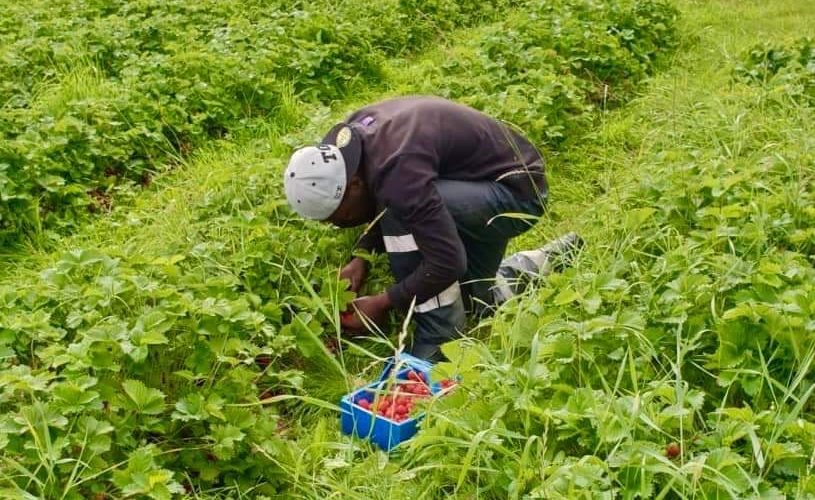
Exploitation of immigrants means an unjust situation when an employer gets benefits from an immigrant worker’s disadvantages.
How does exploitation of migrant workers look like in Finland?
- paying less than required in the work agreement
- paying less to migrants than to Finns demanding working for long hours so that workers have little or no free time
- not letting a worker to have other work contracts outside their first work
- providing workers with bad apartments / living conditions
- taking a worker’s documents away such as their passport
- threatening a worker or their family (Ollus, 2016).
Exploiting workers, employers may abuse what a worker is vulnerable in:
– lack of language skills
– lack of contacts with people and organizations
– not knowing workers’ rights
In order to exploit, employers can
– manipulate with work contracts
– lie to a worker about working conditions (Ollus, 2016)
In 2022, Liza Kuznetsova arrived at a berry farm next to the lake in Leppävirta, not far from Kuopio, Finland. Unlike others, she already had a residence permit and decided to come to the farm to explore what work there would look like. Besides her, there were about 15 Russians, one Ukrainian and 3 Congolese. Next is what she writes about her experiences of work on the farm.

“The conditions were poor. Rooms for 4-8 people in the barracks. Dirty toilet and shower with water which always ends.”


Lisa also tells that she noticed that her employer lied to her about how long she had to work:
“Already on the farm employer notified me that conditions have changed and now workers wake up at 3am to start working at 4am (before it was 6am). We have half an hour break at 8am and then work till 2pm.”
The work on a berry farm was hard:
“On the first day my backache appeared 15min after I started collecting berries.”
“Sometimes before bringing another basket to the weights I stood up and couldn’t move for half a minute because whole body was hurt. Fingers became swallowed, red and itchy because of strawberries’ acid and water from the morning rain. Nettle bites. Mosquitos bite twice. That day I managed to collect 15 baskets without taking any breaks, what is approx 60 kg of strawberries.”


In addition to the hard work of berry picking, Liza found some other unpleasant things about the work she started to do. The wages weren’t calculated by hours worked but by weight of berries collected, so that the total wages appeared much lower:
“I calculated my salary on that day and by weight it appeared to be 48€! 9 hours of hardest physical work was worth 48€! I hoped that at least I will get my fair minimum salary (81€ = 9€*9h).”
In addition, the employer paid weight-based wages illegally because those wages were lower than the minimal wage stated in Liza and others’ work contracts.
“When signing the contract later that day employer hurried me up so I would not read it carefully saying “don’t worry, everyone has the same”. But I pointed on the line about minimum wage and asked whether I can get this one. He said he pays only by weight, because employees work with different speed and now the market price goes down. When I said that it’s simply a Finnish law he changed in face, took the unsigned contract from my hand and said that he will bring me back to the bus stop in the evening if I do not agree with his condition…”
Reasons of exploitation
Why is there exploitation of migrant workers in Finland?
The main reason why exploitation of migrants exists in Finland is globalization.
Globalization (Humphreys, 2023) means a process in world society when different societies, people, cultures, and countries are getting more connected with each other. With globalization, powerful individuals and organizations can influence distant people and places across the glove.
Such powerful organizations could be international companies that supply supermarkets in Finland with berries, fruits, other products. Finnish companies now have to compete not only with each other but also with them. As a Finnish company, you’ll be interested in getting profits, which you get when people buy your products. When other companies arrive, you’ll be interested in that Finnish people would buy your products and not the ones of foreign and other domestic companies.
Liza’s employer mentioned that “now the market price goes down.”
“Other employees told me that this year there were not enough workers on the farm and many strawberries were already overripe, so you have to spend much more time in selecting the perfect-looking ones and separating them from leaves (new requirement from the employer).”
As an average person coming regularly to the store to buy some strawberries or blueberries and, say, cook a pie for an evening tea time, you’d be probably interested in the good ones that cost only €6 instead of the good ones that cost €12.
For a company, it’s reasonable to decrease the price for a package of such strawberries or blueberries, so that when you come to the store, you’d buy their package instead of a foreign one.
How can a company decrease a price? A company may decrease the salaries of people who work on berry farms before the packages of berries appear in the supermarket. Additionally, a company may spend less for living conditions where workers live or remove worker benefits, that all will decrease the final price for a package of berries.
“I calculated my salary on that day and by weight it appeared to be 48€! 9 hours of hardest physical work was worth 48€! I hoped that at least I will get my fair minimum salary (81€ = 9€*gh).”
“Thus, physically you couldn’t make enough baskets so that their weight multiplied by the price by kilo (1,06€/kg) would be equal at least the minimum hourly wage (9€/hour) multiplied by the number of hours you work.”
When salaries fall down and living conditions get worse and benefits disappear, Finnish people may not really be interested in working for such companies. So a company may look for people who would like to come to Finland from other countries and who would accept such conditions.
Not any person from a foreign country would work in harsh conditions, but often it’s those people who are in need for various reasons. They may need to get some money to pay debts or to care for their heavily diseased parents, to reach the income threshold to get a residence permit and stay in Finland or to bring their family with them. For these people, working in bad conditions allows them to try to reach their needs.
“Someone told me that Finns would not work for such a low salary, but I have several Finnish friends who went strawberry picking couple of years ago.” “employer intentionally didn’t hire Finns, because they know their rights and will fight for them, while it’s so easy to abuse people in vulnerable situation (like Russians and Ukrainians nowadays) who are afraid to loose even that little they can get there.”
“My roommate appeared to be another Russian girl my age. When we were in the bed she said she is dreaming of pickled cucumbers and a piece of pork fat (tradition dish in Ukraine and Russia). I realised she was hungry and didn’t have nice food for a while. All her food was eggs, bread, instant noodles and sausages.” “When I suggested to buy groceries the next day she said she doesn’t have money and have to pay her debts so she refused.”
“Someone told me that Finns would not work for such a low salary, but I have several Finnish friends who went strawberry picking couple of years ago.” “employer intentionally didn’t hire Finns, because they know their rights and will fight for them, while it’s so easy to abuse people in vulnerable situation (like Russians and Ukrainians nowadays) who are afraid to loose even that little they can get there.”
“My roommate appeared to be another Russian girl my age. When we were in the bed she said she is dreaming of pickled cucumbers and a piece of pork fat (tradition dish in Ukraine and Russia). I realised she was hungry and didn’t have nice food for a while. All her food was eggs, bread, instant noodles and sausages.” “When I suggested to buy groceries the next day she said she doesn’t have money and have to pay her debts so she refused.”
People who arrived in Finland may not speak the local language well and may not know their worker rights well either. Because of this and because of their needs and restrictions (for example, on where can a migrant work), what is inacceptable for Finns may look like or even be one of few choices for them.
Even when they reveal being exploited, they may still not want to address the issue to a lawyer out of fear of not being able to stay in Finland, to pay their debts, to bring their family members to Finland or other negative consequences. Their vulnerability pushes them to work in exploitative conditions and to even keep them hidden, which, in turn, is beneficial for employers.
Because foreign workers’ situation is dependent on their employers, they themselves hide the conditions of exploitation in fear of negative consequences for themselves.
“I came back to the farm and started talking to others:
Lera: “I know he tricks us but what can we do?”;
Iskander: “Oh I didn’t know there was some minimum salary. I do not speak English so I didn’t even understand the contract”;
Irina: “Yeah, I know he underpays me at least twice, but I am in that situation that I need at least some money”.
Natalia even tried to justify the employer: “The market price goes down, so that’s why he forces us to collect more and underweights the baskets. He needs to adapt. It’s understandable”
“She was scared. She asked what will be the consequences for her, what if the employer cancels her visa (?), what if they forbid her to enter Finland again.”
Some people are concerned about companies exploiting migrants or some other groups of people.
It’s important to remember that not just companies, but consumers are also involved in driving exploitation, and consumers and workers are linked together (Allen, 2022): consumers push companies to decrease their prices, and in order to do that in search for cheap labor companies start to exploit their workers.
Consumers’ wish to buy cheap products and services (food, cleaning, personal assistance etc) is satisfied at the expense of migrant workers’ security and decent working conditions. That’s why action among consumers is important.
What can we do?
We can boycott the companies that harm their workers, that is, avoid buying their products in the stores and as consumers provide a negative feedback on what they do by decreasing their benefits.
We can “buycott” the companies that switch to working conditions respecting their workers. This means that as consumers, we can prefer buying their products and by this provide a positive feedback on how they act.
We can also lobby certain policy makers, write petitions, and start campaigns that help those who disagree with how exploiting companies work, unite and demand changes.
We can produce some information packages or magazines with the lists of companies that exploit their workers or provide them fair work conditions.
Because exploitation is driven by increased competition between companies due to new companies appearing in local markets as a result of globalization, we can also ease that competition by deliberately choosing the products of local companies who provide fair work and salaries to their workers.
References:
Allen, J. (2022) ‘Big retail and the rest: winners and losers’ in Allen, J., Blakeley, G. and Staples, M. (eds) Understanding social lives, part 1. 2nd edn. Milton Keynes: The Open University, pp. 153-190
Andorfer, V. (2015) Ethical Consumers, Editor(s): James D. Wright, International Encyclopedia of the Social & Behavioral Sciences (Second Edition), Elsevier, pp. 25-30
Humphreys, D. (2023) ‘Global heating: exploring the relationship between the local and the global’, in P. Redman (ed.) Global challenges: social science in action 1. Milton Keynes: The Open University, pp. 75-105
Glossary. Available at: https://home-affairs.ec.europa.eu/networks/european-migration-network-emn/emn-asylum-and-migration-glossary/glossary/exploitation_en (Accessed: 8 October 2024)
Ollus, N. (2016) From forced flexibility to forced labour: the exploitation of migrant workers in Finland. European Institute for Crime Prevention and Control, affiliated with the United Nations (HEUNI): Grano Oy, Tampere, Finland. European Commission. Migration and Home Affairs.